One of the first decisions a charity faces when building or rebuilding a website is the platform question: WordPress, or a fully custom build? Both are legitimate choices, but they suit different situations. Here’s a practical breakdown based on what actually matters for a UK charity’s website – not a generic “pros and cons” list.
The Short Answer
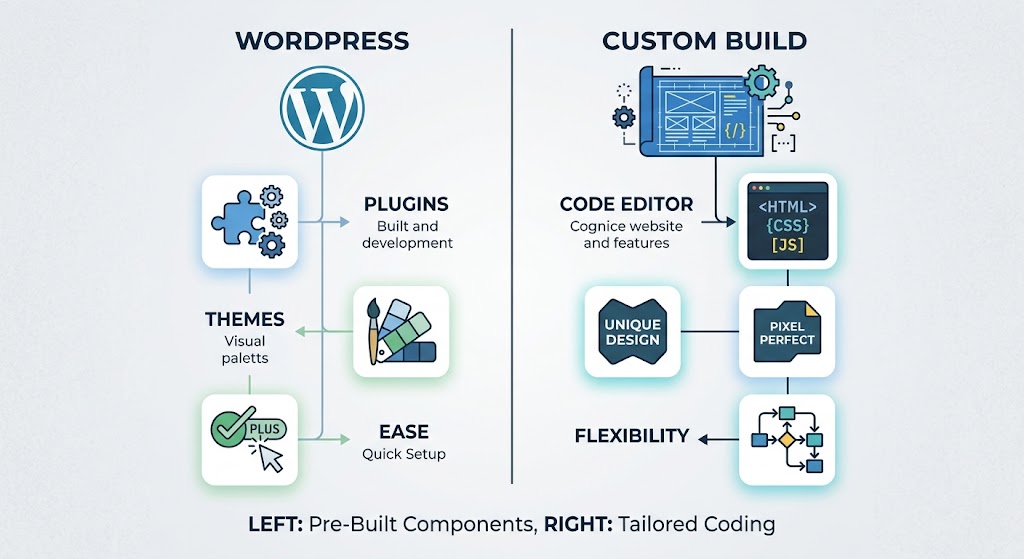
Most small-to-medium UK charities are better served by WordPress. It’s faster to launch, cheaper to maintain, and has mature plugins for the things charities specifically need – Gift Aid-aware donation forms, event/volunteer management, newsletter integration, and accessibility tooling.
Custom builds make sense when your charity has specific technical requirements a plugin ecosystem can’t cleanly satisfy – a bespoke donor portal, a complex multi-currency international donation flow, tight integration with an existing CRM via API, or performance demands that a typical WordPress stack struggles with at scale.
Where WordPress Wins
Speed to launch. A well-built WordPress site can go from brief to live in weeks, not months, because so much of the underlying functionality (forms, blog, media handling, SEO tooling) already exists and just needs configuring rather than building from scratch.
Cost of ongoing maintenance. Charities are often volunteer-run or have small staff teams. WordPress’s massive ecosystem means routine tasks – content updates, adding a new appeal page, swapping images – can often be done by non-technical staff directly, without needing to go back to a developer for every small change.
Plugin maturity for charity-specific needs. Gift Aid-aware donation plugins, GDPR-compliant newsletter signups, and accessibility-focused plugins are mature and well-tested on WordPress specifically, because so many charities use the platform – you’re benefiting from a large existing user base finding and fixing issues.
Lower long-term cost. Without the overhead of custom development for every feature, WordPress builds are generally cheaper to both build and maintain over a multi-year period.
Where Custom Build Wins
True architectural flexibility. If you need something WordPress genuinely wasn’t designed for – a highly bespoke donor dashboard with real-time data, tight two-way sync with an external CRM, or a donation flow with unusual logic – a custom build avoids fighting against a CMS that wasn’t built for your use case.
Performance at scale. For very high-traffic charities (think large-scale national appeals with major traffic spikes), a lean custom build can be tuned more precisely than a general-purpose CMS, though modern caching and hosting can close much of this gap for WordPress too.
Full control over every line of code. Some organisations, particularly larger ones with in-house technical teams, prefer full ownership of the codebase without depending on third-party plugin maintainers for critical functionality.
The Real Trade-off
The honest version of this decision isn’t “WordPress vs custom” in the abstract – it’s “how much of what you need is standard, and how much is genuinely unusual.” Donation forms, Gift Aid, event pages, volunteer sign-ups, blogs, and accessibility – these are solved problems on WordPress. If your charity’s needs are 90% standard and 10% unusual, a hybrid approach (WordPress core with a custom plugin or two for the unusual part) is often the most cost-effective path, rather than building everything from scratch.
A Practical Way to Decide
Ask these three questions:
- Do we have in-house technical staff, or are we relying on external developers for every future change? (WordPress favours the latter scenario heavily)
- Is our functionality mostly standard charity-website needs, or do we have a genuinely unusual requirement? (Standard → WordPress; unusual → consider custom, or a hybrid)
- What’s our realistic maintenance budget for the next 2-3 years, not just the initial build? (WordPress is typically cheaper here)
For the large majority of UK charities, particularly small and mid-sized ones without a dedicated technical team, WordPress remains the pragmatic choice – not because it’s a compromise, but because the ecosystem genuinely covers what most charities need well.