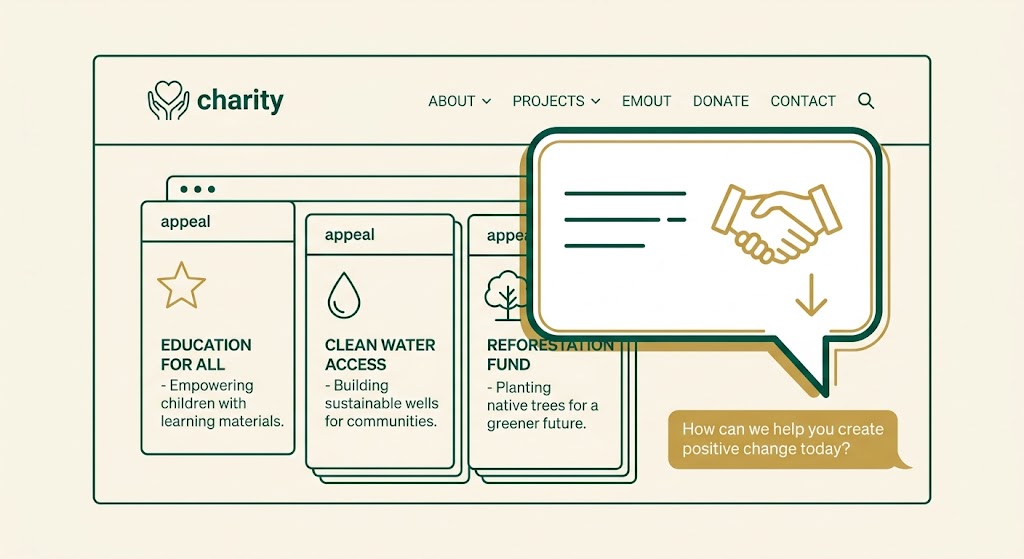
Most charity websites already contain everything a supporter needs to give – country pages, live appeals, prices, an events calendar, a volunteering form. The problem isn’t missing content. It’s that supporters rarely find it before they give up and leave.
A well-built chatbot solves a narrower problem than people often assume, and that narrowness is exactly what makes it useful. It doesn’t replace your website’s content – it helps visitors actually find it.
The Real Problem Isn’t “We Need AI”
It’s easy to hear “chatbot” and assume it’s about looking modern or keeping up with a trend. For a charity, the actual case is more specific and more practical:
- A visitor lands on your homepage wanting to help with a specific thing – “clean water,” “Gaza,” “orphans” – and has no idea which of your twelve appeal pages covers it
- Staff spend real hours each week answering the same handful of questions by email that are already answered somewhere on the site
- A supporter who’s ready to give abandons the process somewhere between “I want to help” and an actual completed donation, simply because the path wasn’t obvious
None of this is a content problem. It’s a findability problem – and that’s specifically what a chatbot is good at solving, when it’s built correctly.
What “Built Correctly” Actually Means
Not all charity chatbots are equal, and the difference matters more than it might seem. Before choosing one for your site, check for these specifically:
Does it read your actual website, or a static script someone wrote once? A chatbot trained on a fixed FAQ document goes stale the moment you launch a new appeal or change a price. One that queries your live site content (your actual WordPress posts and pages) stays accurate without anyone having to remember to update a second system.
Does it invent things when it doesn’t know the answer? This is the single most important check. A chatbot that confidently makes up a campaign, an amount, or an event date that doesn’t exist isn’t a convenience – it’s a liability, especially for an organisation whose entire relationship with the public runs on trust. Ask any provider directly: what happens when it doesn’t have an answer? The honest answer should be “it says so and links to a real page,” not a guess.
Does it hand off to your actual checkout, or a separate payment flow? A donation captured mid-conversation still needs to go through your existing, trusted payment gateway and Gift Aid process – not a bolted-on separate system that adds friction or, worse, a second place donor data has to live.
Is it upfront about being recorded? Under UK data protection expectations, a visitor should know if their conversation is being logged before they start typing – a welcome message with a clear privacy notice and a link to your policy isn’t optional polish, it’s the baseline.
Can your own team see what’s being asked? A chatbot with no visibility into its own conversation history is a black box. Being able to review what visitors are actually asking is useful both for spotting gaps in your website content and for basic accountability.
Where This Fits Alongside Everything Else
A chatbot isn’t a replacement for a well-structured website, clear navigation, or a strong Gift Aid-ready donation form – all things we’ve covered in previous posts. It’s a layer on top of that foundation, for the visitors who arrive with a specific question and don’t want to browse to find the answer. If your underlying site content and donation flow aren’t solid yet, that’s genuinely the higher-priority fix first.
What This Looks Like in Practice
We’ve built exactly this kind of assistant – called CharityBot – specifically for UK charity websites, with the checks above built in from the start: grounded in live site content, honest about what it doesn’t know, hands off directly to your existing cart, and fully reviewable by your team. It’s currently live on a real UK charity site today.
If you’re weighing whether this is worth exploring for your own charity, see how it works or get in touch for a walkthrough on your actual site rather than a generic demo.